Introduction
In plastic injection molding, water cooling is the main method used to keep machines and related equipment at a stable working temperature. Water absorbs excess heat and carries it to a cooling tower or chiller, where the heat is released before the water cycles back into the system.
Why is stable temperature so important? Many people think that as long as the machine doesn’t overheat, it’s fine. But in reality, the situation is more complex. Hydraulic machines work best at around 40–50°C. If the temperature is too high, seals wear out faster and the machine loses power. If the temperature is too low, the machine becomes sluggish.
For molds, low mold temperatures reduce the flow of molten plastic and may cause short shots. High mold temperatures can lead to thermal degradation, higher shrinkage, and poor dimensional accuracy. Keeping mold temperatures stable reduces variations, improves product stability, and ensures consistent quality. This is why the cooling system must be maintained regularly to prevent product defects.
Although air cooling exists, water cooling is far more common because water has better heat transfer and storage capacity. This makes water cooling more efficient and cost-effective. However, water cooling systems also come with drawbacks—pipes, cooling towers, and pumps can eventually suffer from scaling and corrosion. Over time, impurities in water such as minerals, acids, and alkalis can build up or cause damage inside the pipes. The following explains how these problems develop and how to solve them.
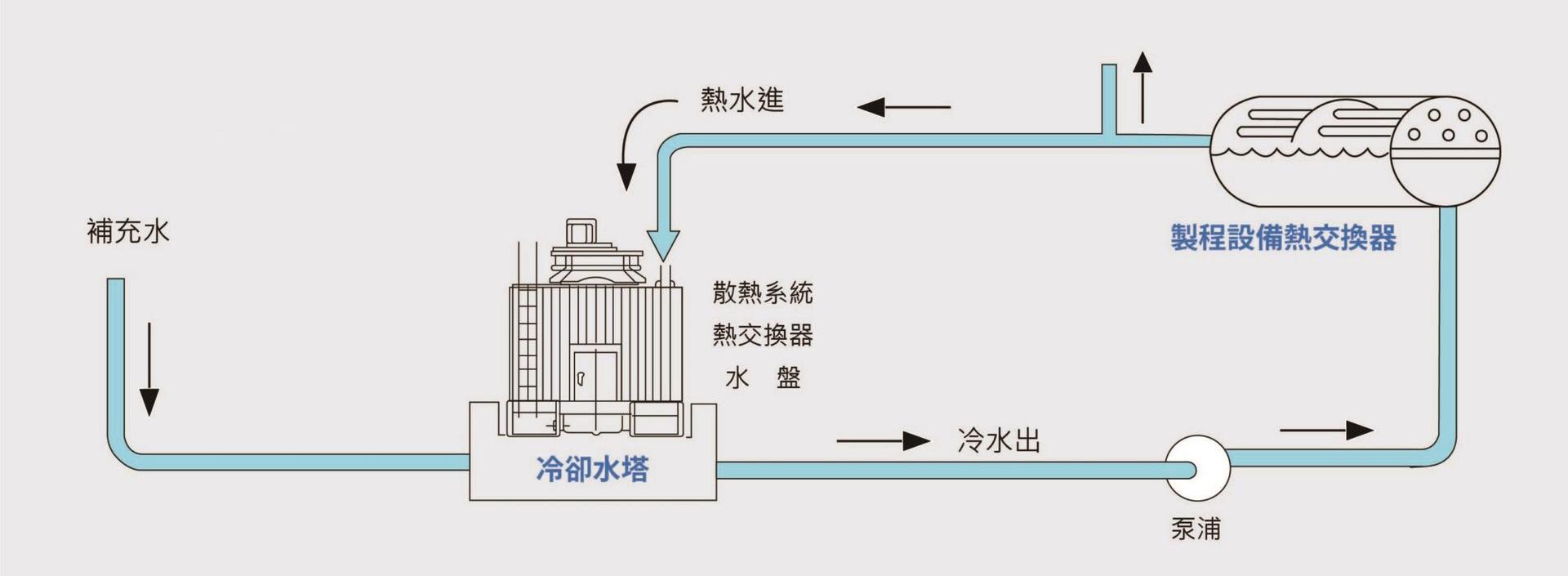
Coolig Watner Cycle
1. The pump sends cold water into the heat exchanger (cooling lines).
2. The water absorbs heat and becomes warmer.
3. The warm water flows to the cooling tower.
4. Heat is released at the tower, and the water cools down.
5. The cooled water returns to the pump (with fresh water added to make up for evaporation).
How Scale Forms
1. Cooling tower runs → water circulates into machines for cooling.
2. Heat causes some of the water to evaporate.
3. Fresh water is added to replace what’s lost.
4. Minerals in the water become more concentrated.
5. Minerals settle and crystallize when heated.
6. Crystals stick to surfaces, forming scale.
7. Over time, scale builds up layer by layer.
8. Cooling efficiency drops.
9. Eventually, pipes get blocked → machines can’t cool properly.
Why Scaling Blocks Equipment
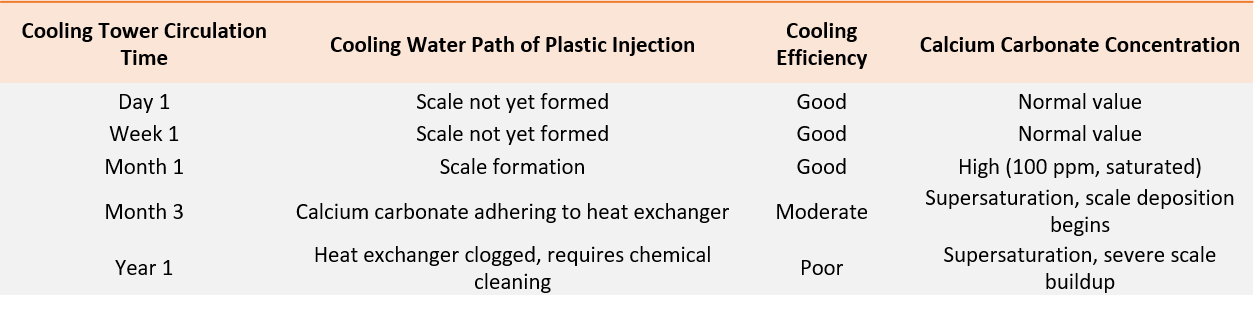
Since cooling towers constantly add water rich in calcium carbonate, calcium levels in the system rise over time. When this water enters a hot heat exchanger, scale forms quickly and sticks to the surfaces of pipes. This reduces heat transfer, eventually causing machines to overheat and shut down.
Scale Formation and Cooling Efficiency Comparison Table
How to Deal with Scaling
1. Maintain proper water flow and speed – low flow makes it easier for scale to stick.
2. Clean regularly – set a cleaning schedule based on water quality.
3. Use chemicals if needed – but note that chemicals may increase corrosion.
4. Switch to a closed system – prevents outside air and dust from entering the water cycle.
5. Install filtration – filters remove impurities that cause scale, slowing down buildup.
Causes of Pipe Corrosion
1. pH level of water – metal pipes corrode faster if water pH is outside 6.5–8.
2. Water speed too high – fast-moving water wears down pipes more quickly.
3. Impurities in the water – particles carried by the flow scrape and damage pipe walls.
4. High pressure – especially in copper pipes, pressure can thin the pipe walls.
How to Prevent Corrosion
1. Check and record pH regularly.
2. Monitor water pressure and flow speed.
3. Filter the water – add filters or water treatment systems to remove impurities.
4. Test water quality regularly – follow JRA standards to ensure circulating water is safe.
5. After chemical cleaning, replace the water – confirm pH is normal before restarting.